Georgia Dog Bite Laws Explained
A comprehensive resource for dog bite victims in Metro Atlanta and across Georgia
Key points about dog bite laws and lawsuits in Georgia
Two paths to compensation
- Prove owner knew dog was dangerous (scienter ground)
- Prove leash law violation (ordinance ground)—Usually easier
No statewide leash law
- Each jurisdiction has its own requirements
- About 30% of counties may lack ordinances
Georgia leash law violations are powerful
- Eliminate need to prove owner’s knowledge
- Transform any dog into legally “vicious” dog
- Provide clear, objective evidence of liability
- Shift burden to owner to prove compliance or exception
Insurance usually covers dog bites
- Most claims covered by homeowner’s insurance
- Typical coverage: $100,000-$500,000
- Provides realistic source of compensation
- Professional adjusters handle claims
Children deserve special protection in dog bite claims
- Cannot legally provoke dogs
- Receive higher compensation for permanent scars
- Face lifetime impact from injuries
- Parents can also recover damages
When a dog attacks in Georgia, victims often face a confusing maze of state statutes and local ordinances. Many dog bite victims assume they can’t recover compensation because:
- The dog never bit anyone before: It doesn’t matter if the leash law is violated.
- I was on the owner’s property: You can still recover if you were lawfully present.
- The owner was nice and apologized: That doesn’t eliminate their legal liability.
- The dog has since been put down: That doesn’t affect your claim.
- It’s just a scar: Scars are compensable, especially facial scars and scars on children.
- The owner doesn’t have money: Their insurance likely covers the claim.
The reality is that none of these reasons should prevent you from seeking fair compensation. In this comprehensive guide, we’ll explain how Georgia’s unique dog bite laws work, why local leash laws matter so much, and what you need to know if you’ve been injured by a dog anywhere in Georgia.
If you have questions or need help filing a claim after a dog attack in Georgia, schedule a free consultation with the experienced Peachtree Corners dog bite attorneys at McGahren Law.
We can explain your options and negotiate with insurers to get you the full compensation you deserve.
Can I sue for a dog bite in Georgia?
Yes. Georgia law allows dog bite victims to recover damages in 2 ways:
- The traditional route: Prove the owner knew the dog was dangerous (the “one-bite rule”).
- The easier route: Prove the dog violated a local leash law when the attack occurred.
Most Georgia cases succeed using the second route because it doesn’t require proving the owner knew the dog was dangerous. If a dog was off-leash in violation of local law when it bit you, the owner can be held liable even if the dog never bit anyone before.
Understanding O.C.G.A. § 51-2-7: Georgia’s dog bite statute
Georgia’s primary dog bite law, O.C.G.A. § 51-2-7, states:
“A person who owns or keeps a vicious or dangerous animal of any kind and who, by careless management or by allowing the animal to go at liberty, causes injury to another person who does not provoke the injury by his own act may be liable in damages to the person so injured.”
The statute continues with the critical second sentence:
“In proving vicious propensity, it shall be sufficient to show that the animal was required to be at heel or on a leash by an ordinance of a city, county, or consolidated government, and the said animal was at the time of the occurrence not at heel or on a leash.”
Two paths to proving liability in a Georgia dog bite case
The statute creates 2 distinct ways to hold a dog owner liable:
Path 1: The scienter ground (knowledge of viciousness)

To win under this traditional approach, you must prove 3 elements:
- The dog was vicious or dangerous.
- The owner knew the dog was vicious or dangerous.
- The owner carelessly managed the dog or let it run free.
This is Georgia’s version of the “one-bite rule” and can be difficult to prove if the dog has no history of aggression.
Path 2: The ordinance ground (leash law violation)
This simplified path only requires proving:
- A local leash law existed requiring dogs to be leashed or at heel.
- The dog violated that leash law at the time of the attack.
- The violation caused your injuries.
Critical advantage: You don’t need to prove the owner knew the dog was dangerous. The leash law violation itself establishes the dog’s “vicious propensity” under Georgia law.
Why Georgia’s dog bite law is unique
Unlike many states with strict one-bite rules, Georgia essentially eliminated the need to prove a dog’s dangerous history in most cases. Even if a dog has never bitten anyone before, the owner can be held strictly liable if the dog was off-leash in violation of local law when it caused injury.
As Georgia courts have recognized, “the second sentence of O.C.G.A. § 51-2-7 eliminates the scienter requirement and creates liability based upon a violation of a local or county ordinance.”
Bottom line: A leash law violation transforms any dog into a legally “vicious” dog for purposes of liability.
Georgia’s statewide dog control laws
The responsible dog ownership law
Georgia establishes minimum standards for dog control under the Responsible Dog Ownership Law (O.C.G.A. § 4-8-20 et seq.) but explicitly allows local governments to create stricter rules. The state law provides a baseline, but your local city or county ordinances likely impose additional requirements.
Important: There’s no statewide leash law in Georgia
Georgia does not have a general statewide leash law. Dogs are not required to be leashed everywhere in Georgia by state law. Instead, leash requirements are determined by local city and county ordinances, which vary significantly across the state.
This makes researching local ordinances absolutely critical for any dog bite case.
Dangerous dog regulations in Georgia (O.C.G.A. § 4-8-29)
Georgia classifies certain dogs as “dangerous” or “vicious.” When a dangerous dog is off its owner’s property, state law requires:
- The dog must be on a leash not exceeding 6 feet.
- The dog must be under the immediate physical control of a capable person.
- Alternative: The dog must be in a locked cage or crate.
Serious penalties for violations of Georgia’s dog bite laws
Dog law violations carry significant consequences:
- Dangerous dog violations: Misdemeanor of high and aggravated nature
- Repeat offenses causing serious injury: Felony charges with 1-10 years imprisonment and $5,000-$10,000 in fines
- Mandatory euthanasia of the dog in serious cases, at the owner’s expense
Georgia dog ordinance comparison table by jurisdiction
| Jurisdiction | Ordinance | Leash max | Voice command? | Key feature | Penalty |
|---|---|---|---|---|---|
| Peachtree Corners | Gwinnett § 10-71 | Not specified | Yes | Voice command; no single-point tether | $1K + 6 mo |
| Gwinnett County | § 10-71 | Not specified | Yes | Voice command alternative | $1K + 6 mo |
| Roswell | Fulton § 34-205 | 6 feet | No | 4-dog max; noise ordinance | Per Fulton |
| Fulton County | § 34-205 | 6 feet | No | Temp tether only (owner present) | Varies |
| Johns Creek | City § 10-6 + County | Varies | Varies | Depends on county location | Citations |
| Atlanta | §§ 18-124, 110-70 | 6 feet | No | Parks have special rules | $100+ |
| Cobb County | § 10-11 | 6 feet | No | On/off property rules clear | Per code |
| DeKalb County | Animal control code | Not specified | No | “Reliable method” required | Per code |
| Sandy Springs | Fulton § 34-205 | 6 feet | No | Same as Fulton | Per Fulton |
| Savannah | § 9-5022 | Not specified | No | City + county ordinances | Per code |
Local city and county dog control ordinances in Georgia
FULTON COUNTY
Ordinance: Fulton County Code § 34-205 – Running at Large
Chapter: Chapter 34 (Health and Sanitation), Article VI, Division 1
Enforcement: Fulton County animal control
Contact: (404) 613-0358
Shelter: 860 Marietta Blvd NW, Atlanta, GA 30318
Scope: Applies to unincorporated Fulton County AND any municipality in Fulton County with an animal control services agreement, including:
- Roswell
- Sandy Springs
- Mountain Park
- Fulton portions of Johns Creek and Alpharetta
- Other Fulton municipalities by contract
Core prohibition:
“The running at large of dogs… is prohibited, with the exception of cats.”
Detailed requirements for dogs (§ 34-205(b)):
- UNLAWFUL for owner/custodian/harborer to allow dog to leave owner’s premises unless:
- Dog is securely on a leash
- Leash is not more than 6 feet long
- Dog is under control of competent person
- Dogs must be confined to owner’s premises by fence, wall, or other enclosure
Electronic confinement system restrictions (§ 34-205(d)):
Electronic (invisible) fences MAY NOT be used for:
- Animals deemed public nuisance 2+ times
- Classified dangerous or vicious dogs
- Dogs in training or trained as guard dogs
Violators must use physical fence/wall/enclosure OR individual leash/chain restraint.
Tethering rules (§ 34-205(e)):
- UNLAWFUL to restrain or anchor dog by tether
- EXCEPTION: Dog may be temporarily restrained by tether while attended by owner/custodian/harborer
- This is the ONLY circumstance tethering is permitted
Dangerous/vicious dogs (§ 34-281):
- Cannot be on street or public place except when:
- Securely restrained by leash not more than 6 feet
- Humanely muzzled when appropriate
- Owner must take reasonable precautions to prevent dog from leaving property while unattended
Legal strategy: Fulton’s prohibition on running at large is absolute. The 6-foot leash maximum is strictly defined. Electronic fence restrictions for dangerous/classified dogs create additional liability grounds. Temporary tethering exception is very narrow—owner must be physically present with the dog.
Source: Fulton County Code § 34-205; § 34-281
ROSWELL
Major service area: Roswell is one of our primary service areas in North Fulton County.
County: Fulton County
Applicable ordinance: Fulton County Code § 34-205
Animal control: Fulton County Animal Services, (404) 613-0358
Shelter: 860 Marietta Blvd NW, Atlanta, GA 30318
City code enforcement: (770) 594-6101
Key requirements (Fulton County § 34-205):
- Dogs must be on a leash no longer than 6 feet when off the owner’s property.
- Leash must be controlled by a competent person.
- Dogs must be confined to the owner’s premises by fence, wall, or other enclosure.
- Temporary tethering only while the owner is physically present.
- Running at large is PROHIBITED.
Roswell city-specific provisions:
- Maximum 4 domestic dogs per property allowed
- Noise ordinance: Owners cannot permit barking, baying, howling, or other noise for:
- More than 10 continuous minutes without interruption, or
- More than 30 minutes if intermittent
How Roswell works:
- Roswell does not operate its own animal control department.
- All animal control calls go to Fulton County Animal Services.
- City Code Enforcement handles nuisance violations (excessive barking, too many dogs).
- Roswell Police respond to immediate dangerous situations.
Legal strategy: Fulton County § 34-205 provides clear liability grounds for any off-leash dog. Roswell’s 4-dog maximum and noise ordinance can provide additional evidence of owner negligence if neighbors previously complained about the dog or if the owner had too many dogs to properly control.
Source: City of Roswell Code Enforcement; Fulton County Code § 34-205
JOHNS CREEK
Unique situation: Johns Creek straddles Fulton and Gwinnett Counties with different ordinances applying based on location.
City ordinance: Johns Creek Code § 10-6 (Running at Large)
Enforcement: Johns Creek Police Department – actively enforces
Contact: Johns Creek PD (770) 513-5190
Which ordinance applies?
- Fulton County portion: Subject to Fulton County Code § 34-205 (6-foot leash)
- Gwinnett County portion: Subject to Gwinnett County Code § 10-71 (voice command alternative)
- Citywide: Johns Creek Code § 10-6 (city-specific provisions)
Johns Creek § 10-6 requirements:
- Dogs must be under restraint when off the owner’s property.
- Running at large is prohibited.
- City ordinance operates alongside applicable county ordinances.
Enforcement reality:
- Johns Creek PD issued public reminders (April 2019) emphasizing active leash law enforcement.
- Officers actively respond to off-leash dog complaints.
- Citations regularly issued.
- Recent example (June 2024): Woman cited after dogs escaped fenceless backyard despite electronic collars
Animal control services:
- Fulton portion: Fulton County animal control (404) 613-0358
- Gwinnett portion: Gwinnett County Animal Welfare (770) 339-3200
Legal strategy: First step is determining which county the incident occurred in—this dictates which ordinance applies and whether voice command defense is available. Johns Creek’s active enforcement record provides good citation evidence. Electronic/invisible fences are not sufficient restraint under any Johns Creek ordinance.
Source: Johns Creek Code § 10-6
DEKALB COUNTY
Ordinance: DeKalb County animal control ordinance
Enforcement: DeKalb County Animal Services
Contact: (404) 294-2100
Key requirements:
- “Duty to Restrain” imposed on all animal owners.
- Dogs must be restrained by:
- Leash, or
- Other reliable method of restraint
- Must be in control of a competent person when away from the owner’s property.
- Running at large is prohibited.
Cities covered:
Decatur, Dunwoody (DeKalb portion), Brookhaven, Chamblee, Doraville, Stone Mountain, Clarkston, Avondale Estates, Pine Lake, Stonecrest, Tucker, Lithonia
Legal strategy: “Reliable method of restraint” language creates flexibility but also opportunity for argument. If dog caused injury, restraint method was by definition not “reliable”—the injury proves inadequacy of restraint.
SANDY SPRINGS
County: Fulton County
Applicable ordinance: Fulton County Code § 34-205
Animal control: Fulton County Animal Services
Key requirements:
- Dogs restrained by fence, wall, other enclosure, OR on leash no longer than 6 feet.
- Must be under control of a competent person when off property.
Exclusions: Dogs in obedience trials, shows, field trials, hunting, or working livestock may be temporarily off-leash in designated areas.
Source: Fulton County Code § 34-205
DULUTH, NORCROSS, LAWRENCEVILLE, SNELLVILLE, LILBURN, SUWANEE, BUFORD
County: Gwinnett County
Applicable ordinance: Gwinnett County Code § 10-71 (see comprehensive Gwinnett section above)
Key feature: Voice command alternative available; single-point tethering prohibited
All these cities contract with Gwinnett County Animal Welfare for animal control services and are subject to Gwinnett’s ordinances.
CITY OF ATLANTA
Ordinances:
City of Atlanta Code § 18-124 (running at large – general)
City of Atlanta Code § 110-70 (animals in parks)
Also subject to: Fulton County Code § 34-205
Enforcement: Atlanta Police; Fulton County animal control
Section 18-124 (running at large):
General prohibition on dogs running at large within city limits, works in conjunction with Fulton County § 34-205.
Section 110-70 (parks – critically important):
“No person shall walk any pet in any park except on a leash, unless the area of the park is explicitly designated as an off-leash dog area.”
Designated off-leash areas ONLY:
- Piedmont Park Dog Park
- South Bend Park Dog Park
Prohibited areas (even with leash):
- Swimming pools and pool areas
- Tennis courts
- Within 15 feet of fences or structures
Penalties:
- First violation: up to $100
- Repeat offenses: escalating fines
Legal strategy: Atlanta parks violations under § 110-70 provide exceptionally clear evidence of leash law violation. Any off-leash dog in an Atlanta park (except the two designated dog parks) creates strict liability under O.C.G.A. § 51-2-7.
Source: Atlanta Code § 18-124; § 110-70
COBB COUNTY
Ordinance: Cobb County Code § 10-11 – Control of animal
Enforcement: Cobb County animal control
Contact: (770) 590-5765
On owner’s premises, all animals shall be kept:
- Indoors, or
- In a primary enclosure containing animal within property bounds, or
- On a leash in hands of person with ability to restrain animal
Off owner’s premises, all animals shall be:
- On appropriate chain, leash, or tie not exceeding 6 feet in length
- In hands of person with ability to restrain animal
Key provisions:
- 6-foot maximum leash length is absolute and strictly enforced.
- “Competent person” means a person with actual physical ability to control that specific animal.
- Both on-property and off-property requirements are clearly defined.
Legal strategy: Cobb’s ordinance is straightforward and unambiguous: 6-foot leash maximum off premises, period. No exceptions, no voice command alternative. On-premises requirement for enclosure or restraint may support negligence claims even if the dog didn’t leave the property.
Source: Cobb County Code § 10-11
SAVANNAH / CHATHAM COUNTY
City ordinance: Savannah Code § 9-5022
County: Chatham County animal control Code
City requirements (§ 9-5022):
Unlawful for any dog to be on streets, lanes, highways, roads, or squares without proper restraint.
County requirements:
Prohibits running at large or off-leash despite the owner’s presence in an unincorporated county.
Legal strategy: Both city and county have leash requirements. Determine whether the incident occurred in city limits or unincorporated county to identify the exact ordinance violated.
ALPHARETTA
Jurisdictional note: Like Johns Creek, Alpharetta spans both Fulton and Gwinnett Counties.
Applicable ordinances by location:
- Fulton County portion: Fulton County Code § 34-205 (6-foot leash, no voice command alternative)
- Gwinnett County portion: Gwinnett County Code § 10-71 (voice command alternative available)
Legal strategy: Determine exact location of incident using address/GPS coordinates to identify which county and therefore which ordinance applies.
COLUMBUS / MUSCOGEE COUNTY
Government type: Consolidated government
Ordinance: Columbus-Muscogee County local ordinances
Requirements:
- Pet owners must maintain control over dogs at all times.
- Cannot leave dogs unattended.
- Must keep on leash or within a secured area (like a fenced yard).
WARNER ROBINS / HOUSTON COUNTY
Ordinance: Warner Robins city ordinances
Requirements:
- Dogs must be leashed or confined while in public.
- Running at large is prohibited.
AUGUSTA-RICHMOND COUNTY
Ordinance: Augusta-Richmond County animal control ordinance Chapter 4-1
Government type: Consolidated city-county government
Requirements:
- Unlawful for dog outside owner’s property without collar
- Leash and control requirements apply
- Running at large prohibited
MACON-BIBB COUNTY
Government type: Consolidated government
Ordinance: Macon-Bibb County animal control code
Requirements:
Dogs must be restrained by:
- Leash, or
- Fence, or
- Other secure means
when outside the owner’s property.
COLUMBIA COUNTY / GROVETOWN
Ordinance: Grovetown leash law ordinance
Requirements (confirmed by Grovetown police chief):
Every dog within city must be:
- Held on leash by owner, or
- Kept within a fenced area.
PAULDING COUNTY
Ordinance: Paulding County animal control code
Requirements:
- Animals must be kept “under control.”
- Dogs must be on leash when outside owners’ properties.
- Must prevent dogs from accessing other properties without permission.
How to determine which dog ordinance laws apply

Step 1: Identify exact location of incident
- Full address
- GPS coordinates if available
- Nearby landmarks/intersections

Step 2: Confirm jurisdiction
- City limits vs. unincorporated county.
- Use county GIS mapping tools.
- Contact the local clerk if uncertain.

Step 3: Identify animal control provider
- Does the city have its own animal control or contract with the county?
- This often determines which ordinance applies.

Step 4: For border areas
- Johns Creek, Alpharetta span multiple counties.
- Determine which county based on the exact address.
- Different ordinances apply in Fulton vs. Gwinnett portions.

Step 5: Verify current ordinance
- Municipal codes can change.
- Check the effective date of the current version.
- Confirm the ordinance was in effect at the time of the incident.
Common leash law elements across Georgia
Almost universal requirements:
- 6-foot maximum is the most common leash length limit (Fulton, Cobb, Atlanta, most cities).
- “Competent person” must control leash—means person with actual physical ability to physically control that specific dog.
- Proper collar/harness attachment required—leash wrapped around neck is insufficient.
- No running at large—prohibited virtually everywhere (cats typically exempted).
- On-property confinement—required by fence, enclosure, or leash.
Rare provisions (jurisdiction-specific):
- Voice command alternative: Gwinnett County ONLY.
- Temporary tethering: Allowed in Fulton County if the owner is present.
- Trolley systems: Gwinnett County has specific requirements.
Unique Gwinnett County provisions
Voice command alternative:
- Dog may be off-leash if obedient to voice command.
- Person giving commands must be in immediate proximity.
- Very rare provision—almost no other Georgia jurisdiction allows this.
Defense strategy against voice command claim:
If a dog caused the injury, the injury itself proves the dog was not “under control” or “obedient” to voice commands. The attack demonstrates the owner lacked adequate control despite claims of voice command training.
Single-point tethering ban:
- Absolute prohibition—no exceptions.
- Cannot tether dog to single fixed point (tree, post, stake, etc.).
- Trolley system ONLY authorized tethering method.
- Violation provides clear, simple path to liability.
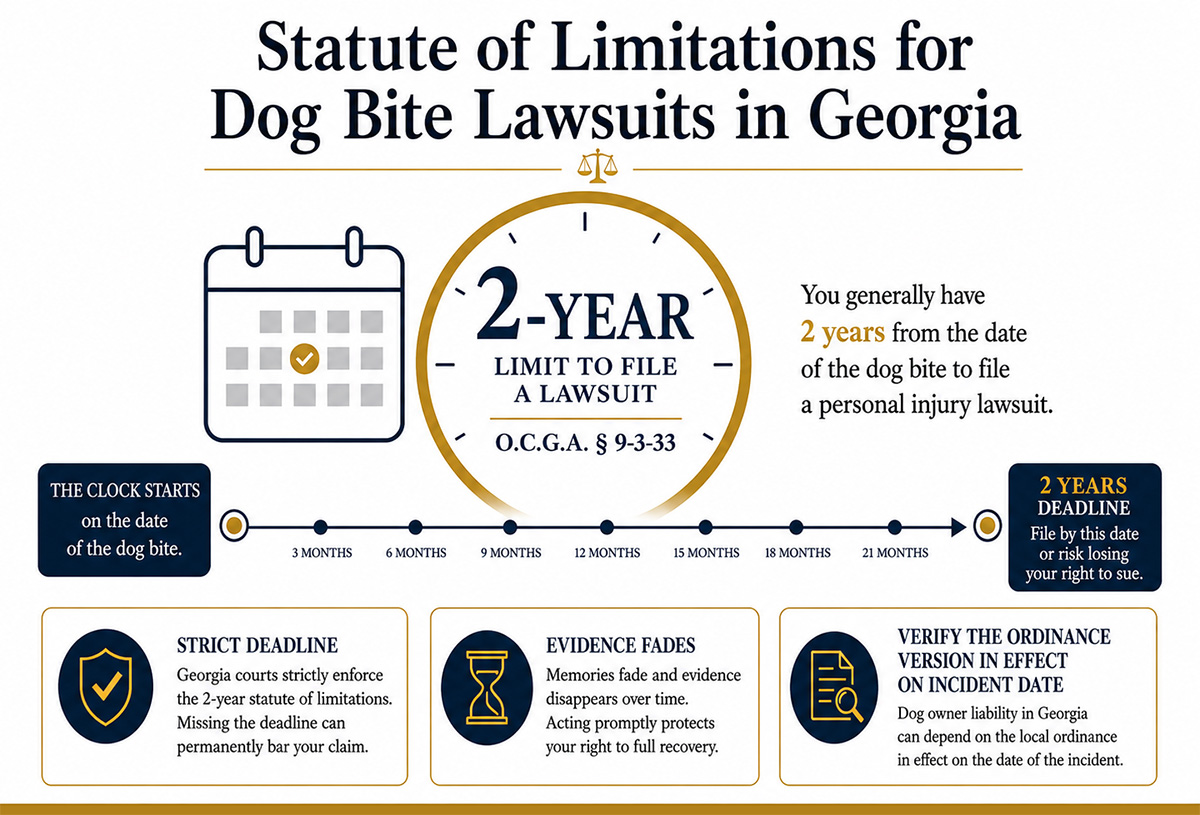
Statute of limitations for dog bite lawsuits in Georgia
Georgia law: O.C.G.A. § 9-3-33
- 2 years from date of injury to file lawsuit.
- This is a strict deadline.
- Missing the deadline bars your claim permanently regardless of injury severity.
Practical considerations:
- Evidence disappears over time.
- Witnesses’ memories fade.
- Building a strong case takes time.
- Do NOT wait until near the deadline to consult an attorney.
- Some cases require extensive investigation before filing.
Ordinance amendment issues:
- Always verify which version of ordinance was effective at the time of the incident.
- If the ordinance is amended after your incident, the prior version applies.
- You’re entitled to rely on the law in effect when the injury occurred.
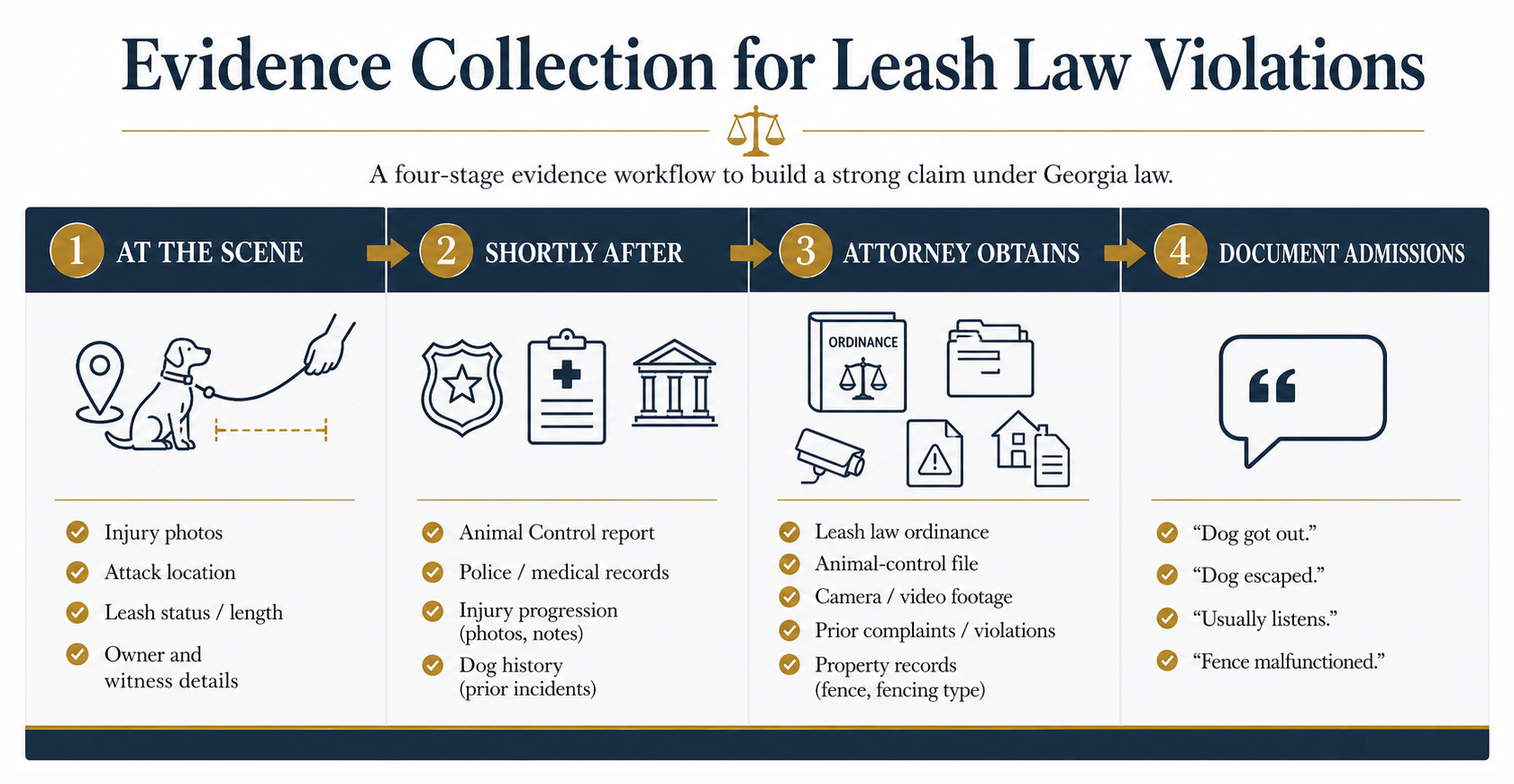
Evidence collection for leash law violations
Immediate evidence (collect at scene):
- Photographs of your injuries (multiple angles, close-up and full body)
- Photos of attack location (where you were standing, where dog came from)
- Photos showing absence of leash on dog
- If leash present, measure and photograph length (over 6 feet?)
- Dog owner’s name, address, phone number
- Dog description (breed, color, size, collar/tags)
- Witness names and contact information
- Document whether owner was present and within voice command distance
Shortly after incident:
- Call animal control immediately—creates official report
- Police report if available (police may not respond to all dog bites)
- Medical records documenting all injuries
- Emergency room records
- Photos of injury progression (days 1, 3, 7, 14, etc.)
- Veterinary records for dog (vaccination status, prior aggressive incidents)
- Animal control history on the dog
- Prior complaints to HOA, neighbors, property management
For your attorney to obtain:
- Copy of applicable local ordinance in effect at time of incident
- Animal control complete file on dog and owner
- Any prior animal control calls to that address
- Surveillance or doorbell camera footage from nearby homes
- Neighborhood Facebook/Nextdoor posts about dog
- HOA correspondence about dog
- Property records (who owns property where dog lives)
Owner admissions (document these):
- “Dog got out.”
- “Dog escaped.”
- “I don’t know how it happened.”
- “He’s usually so good.”
- “She listens to voice commands usually.”
- “The invisible fence must have malfunctioned.”
- “I was just inside for a minute.”
- Any admission dog was not on leash or under control.
Practical guide for dog bite victims in Georgia
How to establish liability after a dog attack in Georgia
Under O.C.G.A. § 51-2-7 Ordinance Ground, you prove liability by showing:
- Local leash law existed requiring dogs to be leashed or at heel.
- Dog violated that law (was off-leash or running at large) at the time of attack.
- Violation caused your injuries.
- You did not provoke the dog.
You do NOT need to prove:
- Dog had bitten anyone before.
- Owner knew the dog was dangerous.
- Dog had a history of aggression.
- Owner received prior complaints.
The leash law violation alone establishes “vicious propensity” under Georgia law.
What to do immediately after a dog bite
At the scene (if physically able):
- Get to safety—move away from the dog.
- Call 911 if your injuries are serious.
- Take photos of:
- Your injuries
- The dog (from a safe distance)
- Location where attack happened
- Lack of leash or fence
- Get information:
- Dog owner’s name, address, phone
- Witness names and contact info
- Video of the scene if possible
- Do NOT sign anything from the dog owner.
- Do NOT agree to handle it privately.
Within 24 hours:
- Seek medical treatment—even if injuries seem minor.
- Dog bites frequently become infected.
- Medical records are critical evidence.
- Delayed treatment weakens your case.
- Report to animal control—call (numbers listed above for your county).
- Creates an official record.
- Starts the investigation.
- Determines if the dog has a bite history.
- Verifies rabies vaccination status.
- Report to police if:
- Injuries are serious.
- Attack was by a dangerous/vicious dog.
- Owner refuses to provide information.
- Document injuries—take new photos daily showing progression.
- Keep all receipts—medical bills, medications, destroyed clothing, etc.
Within one week:
- Consult a dog bite attorney—most offer free consultations.
- Do NOT talk to the dog owner’s insurance company without an attorney.
- Do NOT accept settlement offers without legal advice.
- Do NOT post about the incident on social media—insurance companies monitor this.
- Get copies of:
- All medical records
- Animal control report
- Police report (if filed)
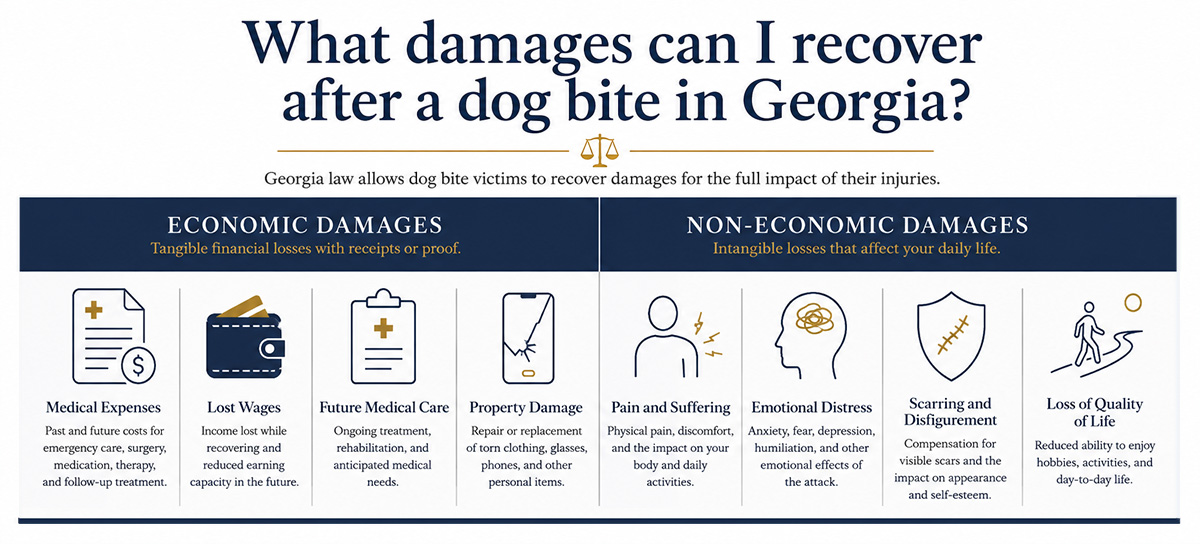
What damages can I recover after a dog bite in Georgia?
Economic damages (compensate for financial losses):
- Medical bills: Emergency room, surgery, ongoing treatment, therapy
- Future medical expenses: Plastic surgery, scar revision, counseling
- Lost wages: Time missed from work recovering
- Loss of earning capacity: If injuries cause permanent disability
- Property damage: Torn clothing, broken glasses, damaged phone, etc.
Non-economic damages (compensate for intangible harm):
- Pain and suffering: Physical pain from injuries
- Emotional distress: Anxiety, depression, PTSD
- Mental anguish: Fear of dogs, nightmares, psychological trauma
- Disfigurement: Permanent scarring, especially facial
- Loss of enjoyment of life: Can’t participate in activities you previously enjoyed
Special considerations for damages:
Children receive higher compensation for scarring because:
- Scars are permanent and affect their entire life.
- Psychological impact is more severe and longer-lasting.
- Social and emotional consequences extend through school years, dating, and career.
- May need multiple scar revision surgeries as they grow.
- Faces change as children mature, potentially making scars more prominent.
Facial scarring increases compensation dramatically:
- Face is visible in all social and professional interactions.
- It cannot be hidden by clothing.
- It has a significant impact on self-esteem and relationships.
- It may require multiple plastic surgery procedures.
- Permanent reminder of the traumatic event.
Psychological trauma is fully compensable:
- PTSD from dog attack
- Fear of dogs preventing normal activities
- Anxiety disorders
- Sleep disturbances and nightmares
- Depression
- May require ongoing therapy/counseling
Permanent injuries substantially increase case value:
- Nerve damage causing loss of sensation or function
- Reduced range of motion
- Chronic pain
- Disability preventing work or daily activities
Defenses dog owners raise (and how to beat them)
Defense #1: “The victim provoked the dog”
Owner’s argument: Georgia law bars recovery if the victim provoked the attack.
How to beat it:
- Simply being near a dog or on the owner’s property is NOT provocation.
- Approaching a dog to pet it is NOT provocation.
- Walking/jogging past property is NOT provocation.
- Young children CANNOT legally provoke dogs.
- Owner must prove provocation—burden is on them.
- Provocation requires an intentional act intended to incite the dog.
Defense #2: “The victim was trespassing”
Owner’s argument: Different duty owed to trespassers.
How to beat it:
- Mail carriers, delivery drivers, meter readers are lawful visitors.
- Social guests are lawful visitors.
- Children may recover under attractive nuisance doctrine.
- Even trespassers may recover for willful or reckless conduct.
- “Beware of Dog” sign does NOT eliminate liability in Georgia.
Defense #3: “No local leash law exists”
Owner’s argument: Can’t violate law that doesn’t exist.
Response:
- About 30% of Georgia counties lack comprehensive ordinances.
- If none exists, use scienter ground.
- Look for prior aggressive behavior evidence:
- Prior bites
- Animal control complaints
- Lunging or charging behavior
- “Beware of Dog” signs
- Owner admissions of aggression
Defense #4: “The dog was on a leash”
Owner’s argument: Complied with leash law.
How to beat it:
- Was the leash longer than maximum allowed?
- Measure and photograph leash.
- Was the handler physically able to control the dog?
- Did the leash break?
- Was the retractable leash extended too far?
- Were there multiple dogs on one leash?
Defense #5: “The dog has an invisible fence”
How to beat it:
- If the dog left the property and bit you, the fence failed.
- Failure proves inadequate restraint.
- Some counties prohibit electronic fences for dangerous dogs.
- Many ordinances do not recognize invisible fences as proper enclosure.
Defense #6: “I have voice command control” (Gwinnett County only)
How to beat it:
- Dog attack proves lack of obedience.
- Owner must be in immediate proximity.
- Voice command requires immediate response.
- Attack demonstrates voice command failure.
How much is a dog bite case worth?
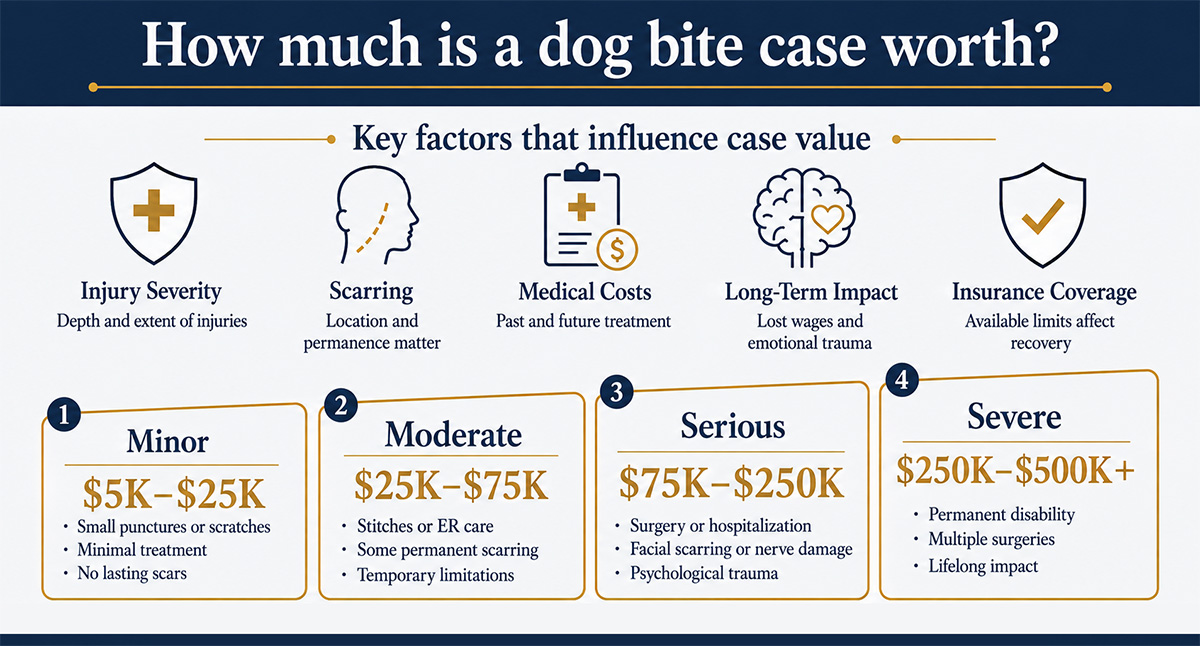
Case value depends on many factors:
- Severity of injuries
- Amount and location of scarring (facial scars worth significantly more)
- Medical bills incurred and anticipated
- Future medical needs (plastic surgery, therapy)
- Lost wages and earning capacity
- Age of victim (children typically receive more for permanent scars)
- Psychological impact (PTSD, ongoing therapy)
- Strength of liability evidence (clear leash law violation increases value)
- Insurance coverage available
Minor cases ($5,000-$25,000)
- Small puncture wounds or scratches
- Minimal medical treatment
- No permanent scarring
Moderate cases ($25,000-$75,000)
- Lacerations requiring stitches
- Emergency room treatment
- Some permanent scarring
Serious cases ($75,000-$250,000)
- Deep lacerations requiring surgery
- Facial scarring
- Nerve damage
- Psychological trauma
Severe cases ($250,000-$500,000+)
- Lifelong impact
- Disfiguring facial scars
- Permanent disability
- Multiple surgeries
Does homeowner’s insurance cover dog bites in Georgia?
Good news: Yes, most dog bite claims are paid by homeowners or renters insurance.
Typical coverage:
- $100,000-$500,000 typical liability limits
- Covers compensation and legal defense
WARNING: Do NOT accept the first settlement offer without consulting an attorney. Insurance companies routinely make low initial offers.
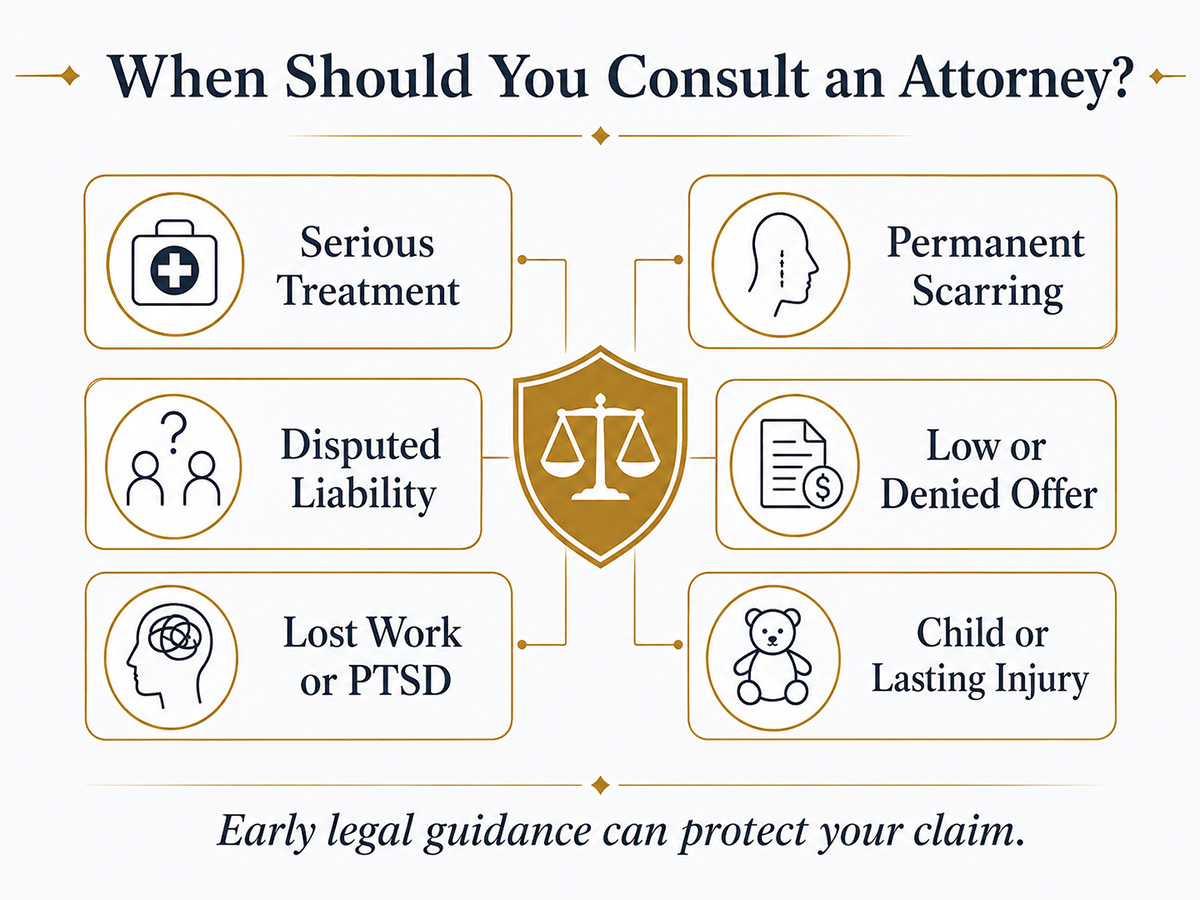
When to hire a dog bite attorney
You should consult an attorney if:
- Injuries required medical treatment beyond basic first aid.
- You have any permanent scarring, especially facial.
- Dog owner denies liability or claims you provoked the attack.
- Insurance company offers a settlement that seems low.
- You’re unsure whether local leash law exists in your jurisdiction.
- Dog owner has no insurance (need to identify other coverage sources).
- Your injuries prevent you from working.
- You’ve developed PTSD, anxiety, or a fear of dogs.
- A child was the victim (higher stakes, more complex damages).
- Multiple surgeries needed or anticipated.
- Nerve damage or loss of function occurred.
- Insurance company delays or denies your claim.
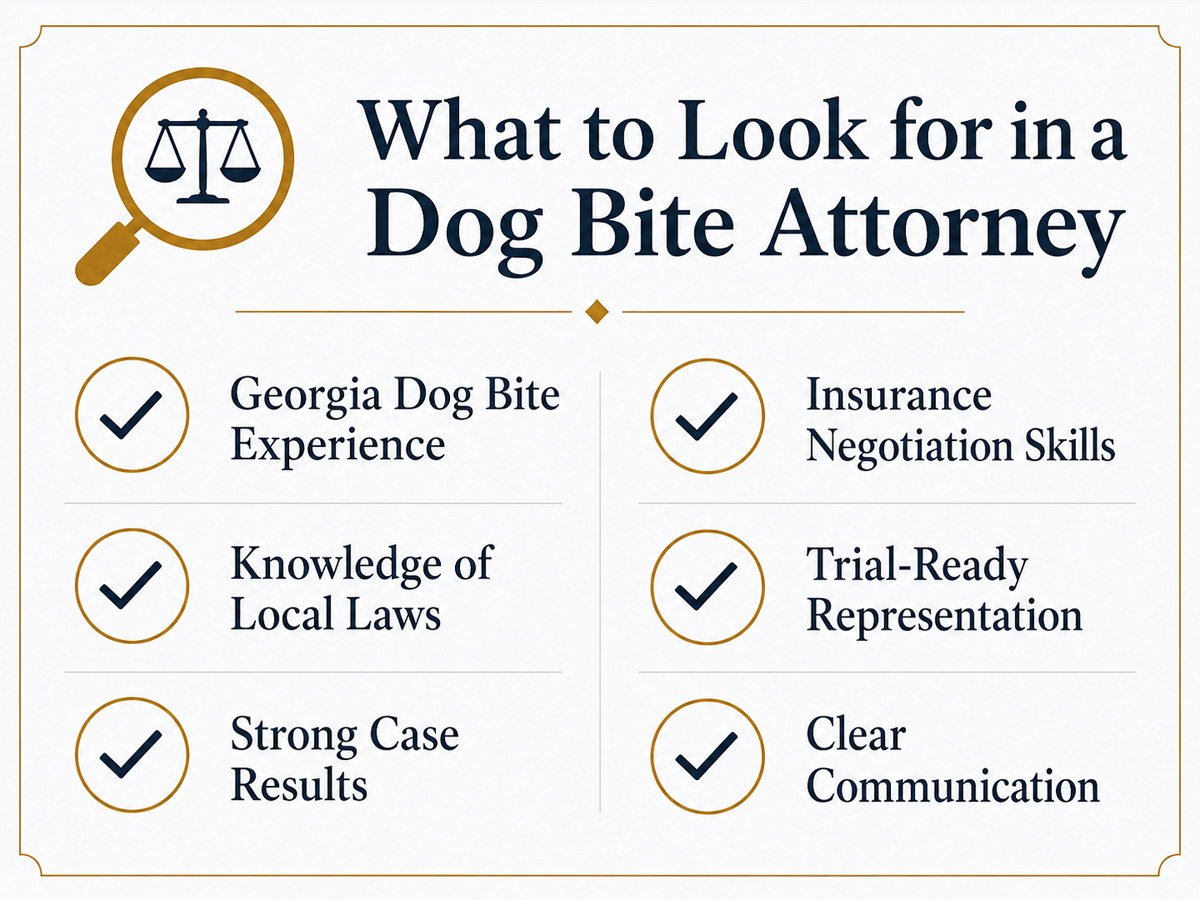
What to look for in a dog bite attorney:
- Specific experience with Georgia dog bite cases
- Understands O.C.G.A. § 51-2-7 and local ordinances
- Has handled cases in your specific county
- Works on contingency fee (no fee unless you win)
- Offers free initial consultation
- Experience negotiating with insurance companies
- Willing to take the case to trial if necessary
- Good reputation with past clients (check reviews)
- Responsive and communicates clearly
- Located in or serves your area
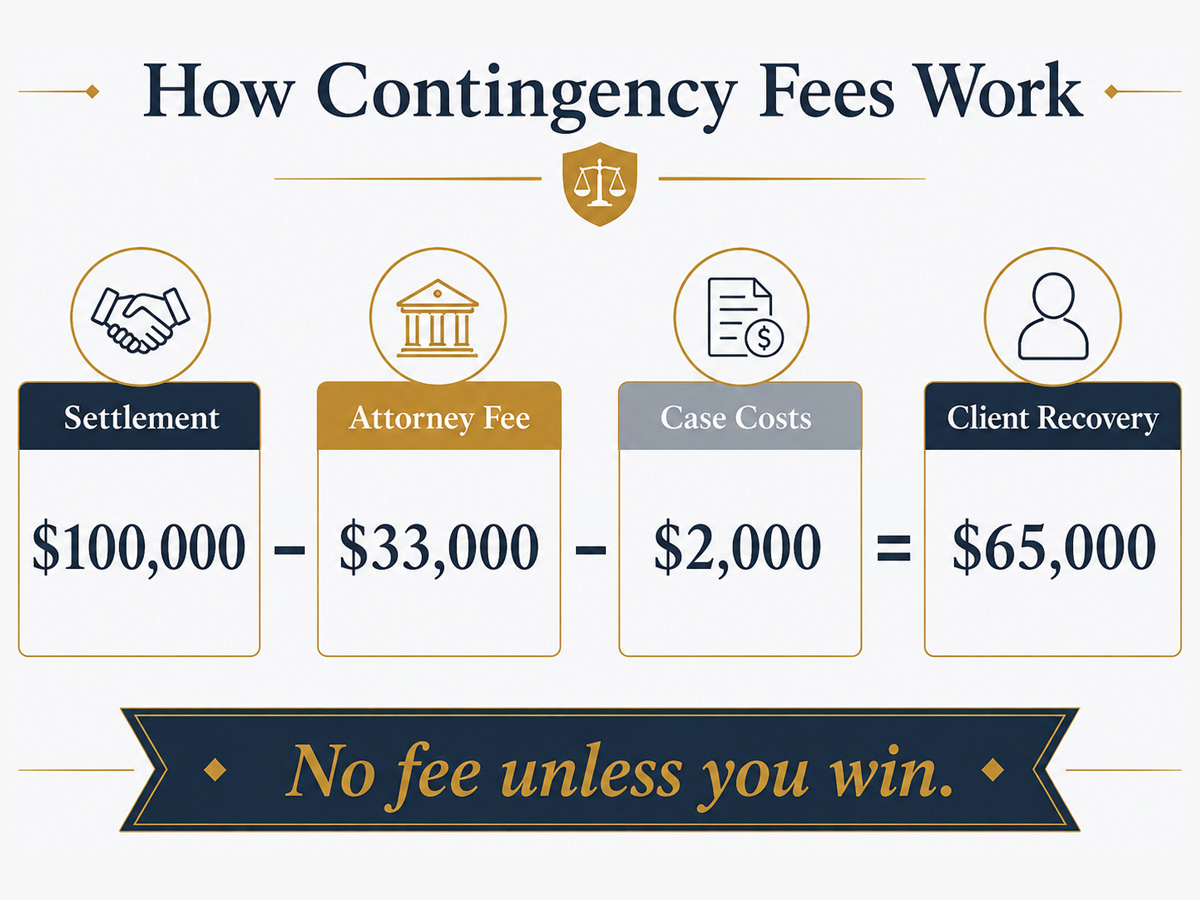
How contingency fees work:
- No money upfront: You pay nothing to hire the attorney.
- Attorney advances costs: Attorney pays for investigation, expert witnesses, and filing fees.
- Pay only if you win: If you don’t recover money, you don’t pay attorney fees.
- Typical fees: 33-40% of recovery.
- You get the rest: 60-67% of settlement or verdict goes to you.
- No risk: If you lose the case, the attorney loses too.
Example:
- Settlement: $100,000
- Attorney fee (33%): $33,000
- Case expenses: $2,000
- Your recovery: $65,000
This arrangement allows victims to hire experienced attorneys regardless of their financial situation.
Frequently asked questions about dog bite laws and lawsuits in Georgia
Under Georgia law, you can still recover compensation if the dog violated a local leash law. You don’t need to prove the dog had a history of biting. The leash law violation itself establishes the dog’s “vicious propensity” for legal purposes.
You can still recover if you were lawfully on the property and didn’t provoke the dog. “Lawfully on property” includes:
- Social guests (invited to home)
- Mail carriers and delivery drivers
- Meter readers and utility workers
- Contractors doing work on property
- Children in some circumstances
Even trespassers may recover if the owner’s conduct was willful or reckless.
You may still have options:
- Your own homeowner’s/renter’s insurance: May have medical payments coverage
- Your health insurance: Covers medical bills (but may seek reimbursement)
- Dog owner’s personal assets: Can pursue owner personally (though often limited)
- Landlord’s insurance: If landlord knew dog was dangerous
- Property management company: If they had control over property
- Other occupant’s insurance: If someone else in home owns the dog
An experienced Georgia dog bite attorney can identify all potential sources of compensation.
Timeframes vary significantly:
- Simple cases: 3-6 months (clear liability, willing insurance company, minor injuries)
- Moderate cases: 6-12 months (some negotiation needed)
- Complex cases: 1-2 years (liability disputed, significant injuries, litigation required)
- Trial cases: 2-3+ years (if case goes to jury trial)
Your attorney can provide a better estimate based on your specific circumstances.
Be very cautious. Insurance adjusters are trained to minimize claims and may:
- Ask leading questions designed to get you to admit fault.
- Record your statements and use them against you later.
- Pressure you to accept quick, low settlement before you know the extent of injuries.
- Claim you don’t need an attorney (you often do for serious cases).
- Downplay your injuries.
- Suggest your injuries weren’t caused by a dog bite.
Best practice: Politely decline to give a recorded statement. Say you’re consulting an attorney first. Do NOT sign any releases or accept any settlement offers without legal advice.
The dog being euthanized or surrendered does not affect your legal claim. You can still pursue full compensation for your injuries even if the dog is no longer alive. The claim is against the owner (and their insurance), not the dog itself.
Possibly, but it’s complicated. If you were trying to protect another person or your own dog from attack, courts may view this favorably. However, voluntarily inserting yourself into a dog fight may be considered assuming the risk. Consult an attorney about your specific circumstances.
Police dog bites raise unique legal issues involving governmental immunity. Georgia law provides some protections to government entities, but you may still have a claim in certain circumstances, especially if:
- Dog attacked without proper command.
- Dog continued attacking after you complied.
- Handler failed to properly control the dog.
- You were not the suspect being apprehended.
Police dog cases require a Georgia dog bite attorney with experience in governmental liability claims.
Service dogs are not exempt from leash laws or liability. If a service dog attacks without provocation, the owner is still liable. The fact that it’s a service dog doesn’t provide immunity. However, approaching a working service dog and distracting it could be considered provocation in some circumstances.
Most dog bite cases settle without trial. Typically:
- 90-95% of cases settle before trial.
- Settlement negotiations occur over weeks/months.
- May require mediation.
- Only 5-10% of cases actually go to jury trial.
Your attorney will advise you as to whether a settlement offer is fair or whether a trial is necessary to get full compensation you deserve.
Georgia’s dog classification system
Understanding how Georgia classifies dogs is important because different rules apply to dangerous and vicious dogs.
Regular dogs (unclassified)
Definition: Dogs with no history of aggressive behavior.
Requirements:
- Subject to local leash laws only
- No special registration or insurance required
- Standard rabies vaccination
Dangerous dogs
Definition: A dog that:
- Without provocation, causes a substantial puncture wound to a human, or
- Without provocation, attacks causing severe injury or death, or
- While off owner’s property, kills a pet animal
Requirements:
- Registration: Must register with local government.
- Warning signs: “Dangerous Dog” signs posted on property (visible from all access points).
- Microchip: Dog must be microchipped with registration info.
- Insurance: Maintain $50,000 liability insurance or surety bond.
- Proper enclosure: Dog confined in secure enclosure on property.
- When off property:
- Leash not exceeding 6 feet
- Under immediate physical control of capable person
- Or in locked cage/crate
- Notification: Must notify dog control officer within 24 hours if dog escapes, bites human, dies, or is sold/given away.
- Moving: If the owner moves, must register in a new jurisdiction within 10 days.
Vicious dogs
Definition: A dog that inflicts serious injury on a person or causes death without provocation.
Requirements: All dangerous dog requirements, PLUS:
- Enhanced confinement: More stringent enclosure requirements.
- Muzzle requirement: Must be muzzled when off owner’s property (even if leashed).
- Cannot be left with minors: Even inside the owner’s home.
- Higher insurance: Often required by local ordinance.
- Cannot be sold/transferred: If classified vicious, cannot be given away.
- Violation penalties: Harsher criminal penalties than dangerous dog violations.
Serious injury defined:
- Broken or dislocated bones
- Lacerations requiring multiple sutures
- Disfiguring avulsions (torn away tissue)
- Requires plastic surgery
- Requires hospital admission
- Creates substantial risk of death
- Transmission of infection or contagious disease
Penalties for dangerous/vicious dog violations
Dangerous dog violations:
- Misdemeanor of high and aggravated nature.
- Subject to enhanced penalties beyond standard misdemeanor.
Vicious dog violations:
- If repeat offender whose dog causes serious injury:
- FELONY charge
- 1-10 years imprisonment
- $5,000-$10,000 fine
- Or both
- Dog shall be euthanized at the owner’s expense.
Why dog classifications matter in a Georgia dog bite case
If you were bitten by a classified dog:
- Stronger liability case (owner knew dog was dangerous).
- Evidence of prior dangerous behavior.
- Owner violated special requirements.
- Higher damages often awarded.
- Criminal prosecution of owner more likely.
If dog should have been classified but wasn’t:
- Evidence that the owner knew or should have known the dog was dangerous.
- Supports scienter ground if no leash law violation.
- May establish the owner’s negligence.
- Shows owner failed to take appropriate precautions.
About McGahren Law Firm
McGahren Law Firm is located in Peachtree Corners and represents dog bite victims throughout Metro Atlanta and across Georgia.
Our services
- Free Case Evaluations – No cost to discuss your case
- Thorough Investigation – We research applicable local ordinances
- Evidence Collection – Professional documentation of your case
- Insurance Negotiation – Experienced in dealing with adjusters
- Aggressive Litigation – Trial-ready when settlement isn’t fair
- No Fees Unless We Win – Contingency fee representation
- Personalized Attention – Direct access to your attorney
If you or a loved one has been bitten by a dog in Georgia, contact McGahren Law Firm for a free consultation.
Research limitations and practice resources
Database scope and limitations
What this guide covers:
- Verified ordinances as of February 2025
- Major Metro Atlanta jurisdictions comprehensively researched
- Major cities across Georgia with confirmed ordinances
- Direct ordinance citations and code section numbers
- Practical application guidance for attorneys
What this guide doesn’t cover:
- All 159 Georgia counties
- All 500+ Georgia municipalities
- Smaller rural jurisdictions (many lack formal ordinances)
- Recent ordinance amendments (always verify current law)
- Approximately 30% of counties lack comprehensive animal control
Always verify:
- Current version of ordinance for your specific case
- Ordinances can be amended by local governments
- Effective date of ordinance (must have been in effect at time of incident)
- Contact local clerk’s office for most authoritative version
How to research local ordinances
Online resources:
- MuniCode.com (library.municode.com)
- Free access to many Georgia municipal codes
- Search by city/county name
- Look for “Animals” chapter (usually Chapter 10 or 34)
- County/city official websites
- Look for “Code of Ordinances” or “Municipal Code”
- Animal control information often in “Services” section
- eLaws.us
- Another free municipal code resource
- Good coverage of Georgia jurisdictions
Direct contact resources:
- County clerk’s office
- Can provide copy of current animal control ordinance
- Can verify effective dates
- Local animal control department
- Knows which ordinances they enforce
- Can provide informal guidance on requirements
- Law library
- County law libraries may have local ordinances on file
- Law librarians can assist with research
Animal control contact directory
Major metro Atlanta
- Gwinnett County: (770) 339-3200
- Fulton County: (404) 613-0358
- Cobb County: (770) 590-5765
- DeKalb County: (404) 294-2100
Other major cities
- Savannah/Chatham County: (912) 652-6575
- Augusta-Richmond County: (706) 790-6836
- Columbus/Muscogee County: (706) 225-4365
- Macon-Bibb County: (478) 803-7500
Disclaimer: This article is for informational purposes only and does not constitute legal advice. Reading this post does not create an attorney-client relationship. Laws vary by jurisdiction and change over time. For advice about your specific situation, please consult a qualified Georgia personal injury attorney. Always verify current local ordinances for your jurisdiction as of the date of your incident.
Last updated: February 2025
Ordinances verified: February 2025
Research coverage: Metro Atlanta (comprehensive), Major Georgia Cities (verified), Statewide (general guidance)
For legal practitioners: This guide is intended as a research starting point. Always verify current ordinances, check for recent amendments, and conduct independent legal research appropriate to your specific case. Local ordinances can and do change. The citations provided were accurate as of the verification date but should be confirmed before relying on them in litigation.